Women’s Rights: A journey to the heart of positive change in Ethiopia

By Nisha Lama Karki, ActionAid Ireland GBV Protection Coordinator

After a short hour-long flight from Addis Ababa to Jimma, our journey was far from over. A five-hour drive lay ahead, taking us through the lush terrain of Omia District in southwestern Ethiopia where the ActionAid’s Women’s Rights Programme III, funded by Irish Aid, is making a huge difference. The drive took us along a winding road through rolling green hills, dense forests and clusters of small houses. Along the way, we passed cattle lazily grazing by the roadside. Our destination was Kuka Kebele in Shey Bench, where we received a joyous welcome from women whose lives are being transformed.

Violation of human rights

Ethiopian women face significant barriers due to legal gaps denying them equal economic and social opportunities. Gender-based violence remains prevalent, with cases of rape, abduction, and excessive dowry demands (up to 100,000 Birr – apprx €694) creating cycles of abuse. Religious and community leaders often push for mediation rather than justice, while the legal system remains weak and creates significant barriers for women in their fight for justice.

Women’s Rights Programme III

The programme works directly with the Bench and Menja communities in Kuka Kebele, focusing on advancing women’s rights through a rights-based approach addressing violence, economic inequality, and resource access. The indigenous Bench community primarily farms, while the unjust stigma that for generations has labelled the Menja community, as “untouchable” has shaped their exclusion from broader society.

The purpose of our visit was to listen, learn and witness the impact of the Women’s Rights Programme III first hand. What we found was more than just data or stories. It was resilience, hope and a community embracing change.

New chapter for women in the Menja Community

One of the striking transformations we witnessed with women from the Menja Community was significant improvement in health, hygiene, and nutrition through training sessions, kitchen gardening, and poultry farming.

But perhaps the most powerful change is that women are stepping forward, breaking the silence, and reporting cases of violence where once they were silent. Seeing them advocate for their rights is both inspiring and a testament to the impact of sustained support and awareness.

Etagen’s story

Before the introduction of the Irish Aid-funded Women’s Empowerment Programme III, life was a struggle for Etagen Mulatu, Chairperson of the Women’s Watch Group which aims to reduce harmful traditional practices and gender-based violence, and encourages women to take leadership roles.

Since ActionAid Ethiopia started working in her community, Etagen told us she has seen positive change, including a reduction in abductions, harmful traditional practices and early marriages.

Because of her membership in a credit cooperative she was able to get a loan of 3000 birr (around €21) which she used to buy two sheep which are now pregnant. She was also given soaps and utilities for personal hygiene by ActionAid.

Etagen said: “When ActionAid Ethiopia began working in our community, so much started to change. Menja women were highly marginalised, and they could not eat with other communities, now we commune and eat together. Ever since ActionAid came, we stopped harmful traditional practices.”

“Men never used to shared work and now after ActionAid Ethiopia’s intervention, work is shared. Women now have a voice in decision making and now women are united.”

Etagen says she now feels confident to raise issues and concerns as a result of the capacity strengthening sessions she has undergone. Her son is becoming a nurse, and she sells tea and coffee, earning income to support her family.

Challenges still exist

While change is happening, deep-rooted inequalities and systemic persist. Discrimination continues to restrict the full participation of women in social and economic life.

GBV remains deeply connected with economic and legal systems, particularly through dowry practices and weak justice structures.

Economic empowerment alone is not enough – social norms must shift. While women participate more in cooperatives and farming, their opportunities remain limited by persistent gender inequalities and resource access barriers.

Hope for the future

Social inclusion is as crucial as economic empowerment. The Menja Community’s experience highlights the need for inclusive policies that create opportunities while dismantling social hierarchies.

Real change requires legal, economic, and societal transformation. Ending violence, discrimination, and economic exclusion demands united effort from communities, leaders, and organisations to create a just future for all.

Read more here.
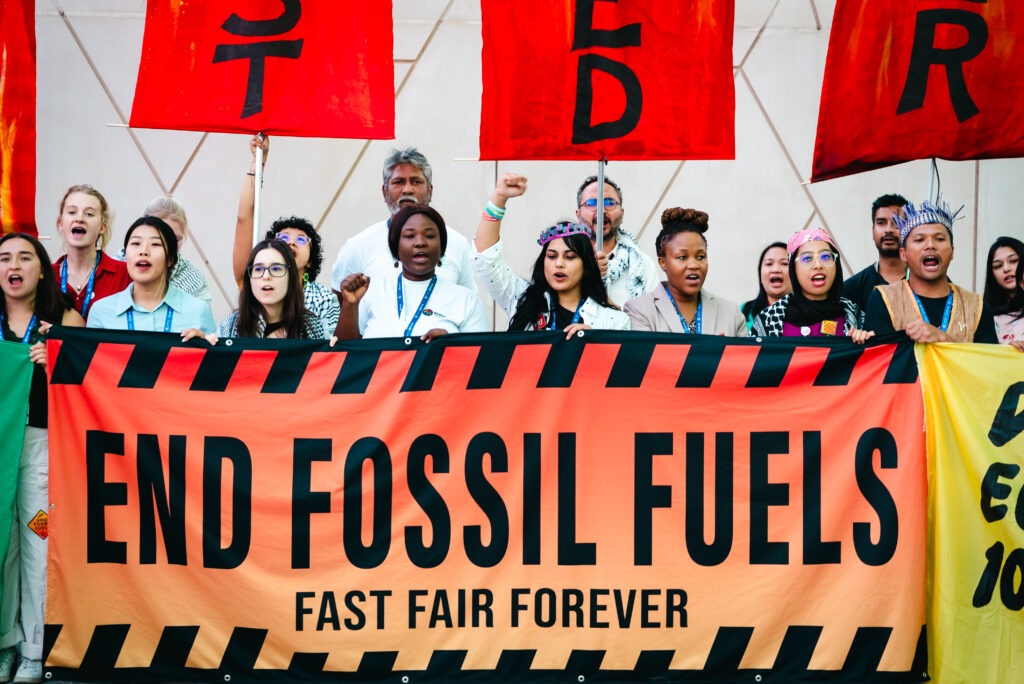
Protesters holding End Fossil Fuels banner at a climate demonstration, advocating for renewable energy solutions.

Protestors at COP 28 in Dubai. Photo: Konrad Skotnicki.

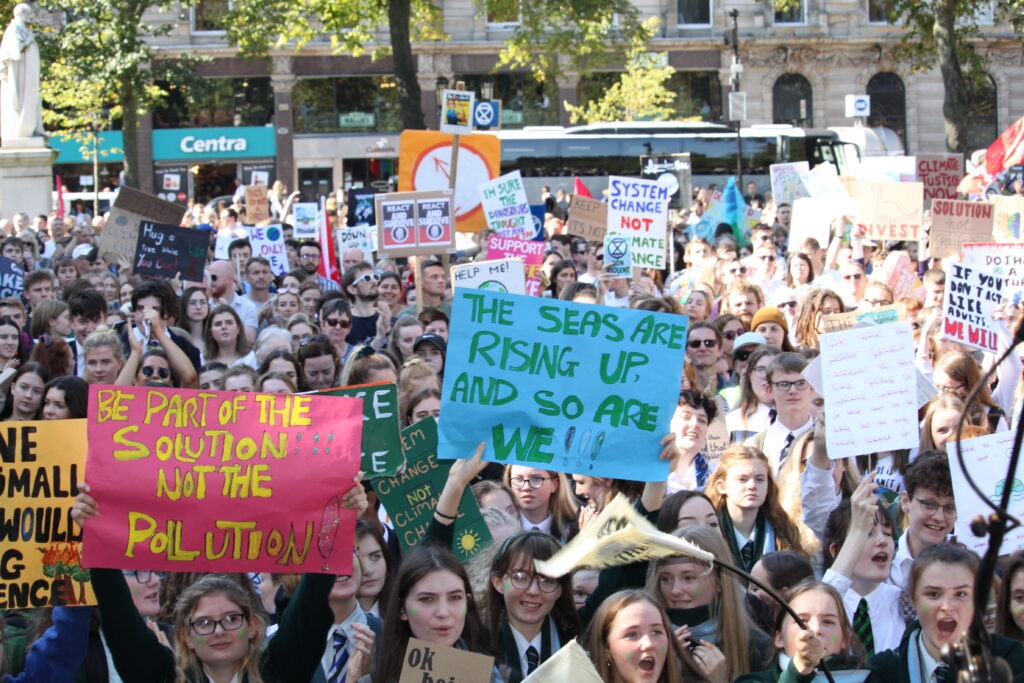
Climate protest with diverse crowd holding signs about environmental action in a city square.

Belfast Climate Change March, 2019. Photo: Trócaire.

The Profit Driving the Crisis

Despite their overwhelming contribution to global emissions, fossil fuel companies continue to attract significant financial backing—driven by their enduring profitability. This is starkly illustrated by the case of ExxonMobil, the top fossil fuel investment held by asset managers based in Ireland. In 2023, ExxonMobil reported €33.63 billion ($36 billion) in profit. That is almost twice the GDP of Botswana (€18.1 billion) and nearly three times Namibia’s GDP (€11.5 billion).

Ireland plays a hugely disproportionate role in facilitating investments into fossil fuel companies like ExxonMobil. In 2023, the investments made into fossil fuel companies by investment managers based in Ireland generated an estimated 72.5 million tons of CO2e. This is more than the CO2e emissions for the entire country of Ireland—and more than ten times that generated by Sierra Leone.

The Global Human Impact

The climate crisis is here, now, and it is causing disproportionate harm in the Global South. In Bangladesh, rising sea levels and increasingly severe cyclones are displacing coastal communities, with projections indicating that 17% of the entire country could be underwater by 2050. The legally binding Paris Agreement on climate change explicitly acknowledges the importance of tackling private finance. Its three overarching goals are: keeping below 1.5C of warming; increasing adaptation and making finance flows consistent with low emissions and resilience.

This gives a clear mandate for action:  both tax reform and corporate regulation are needed to tackle financial flows, and both nationally in Ireland and at EU level, ‘polluter pays’ taxes are lacking and regulation of the financial sector remains weak and fragmented. While EU regulation exists, it is designed more to nudge investors toward more sustainable investment practices by increasing transparency and reporting levels than to enforce strict standards. And it is moving in the wrong direction: the recently passed EU Corporate Sustainability Due Diligence Directive excluded investments; and now the EU Commission’s Omnibus legislative proposal threatens to undo the limited gains made on climate plans, as well as blocking future attempts for stronger action at national level.

The Risk of Inaction

Fossil fuel investment is too profitable to remain weakly regulated. If Ireland continues with its current strategy of encouraging FDI at all costs, and relying on weak EU regulation, we are headed for catastrophe. The Inter-governmental Panel on Climate Change has repeatedly warned that every fraction of a degree beyond 1.5°C brings irreversible consequences: collapsed ice sheets, vanishing coral reefs, and extreme weather events that will make vast regions of the planet uninhabitable. And yet, companies are developing oil and gas fields that could push global warming beyond 2°C.

Our research found that 91% of the investments made into fossil fuel companies by investment managers based in Ireland were to companies that have plans for fossil fuel expansion like these. Ireland cannot afford inaction on this issue.

About This Research

The figures in this report regarding investment from Ireland are based on new research commissioned by ActionAid Ireland and Trócaire. In the paper, we uncover the scale of fossil fuel investment through Ireland, who the investors are, and in which fossil fuel companies they are investing.  We analyse the current regulatory framework and explain why it is inadequate—and moving in the wrong direction. And we make specific recommendations for change, which are summarised below.

Summary of Recommendations

Regulate the private financial sector
Ireland must end its outsized role as an enabler of destructive fossil fuel investment. Ireland should introduce a strong gender-responsive national human rights and environmental due diligence framework which includes the regulation of investors with respect to human rights and the environment and climate. The transposition of the EU Corporate Sustainability Due Diligence Directive could achieve this if downstream activities are included and the Omnibus proposal is rejected. Ireland should prohibit investments in fossil fuel expansion and require investors to implement climate transition plans consistent with a 1.5°C climate limit.

Endorse the Fossil Fuel Non-Proliferation Treaty
Ireland should endorse developing a Fossil Fuel Non-Proliferation Treaty to curb fossil fuel expansion and commit to a fair and funded phase out of fossil fuels.

Support tax justice
Ireland should support bold and fair new global tax rules through the UN Framework Convention on Tax, should adopt all OECD BEPS measures, and should conduct an updated and comprehensive spillover analysis of its tax policy. Ireland should take coordinated action globally, at the EU level and domestically to introduce a range of new taxes to mobilise finance needed for climate justice, based on ‘polluter pays’ and social equity principles such as wealth taxes for the highest earners, climate damages tax on investors, fossil fuel production taxes and levies on aviation and shipping.

Finance a just transition
Ireland must also meet its fair share climate finance obligations under Article 9.1 of the Paris Agreement, and pay our ecological debt to the Global South. Ireland should support conditionality-free debt cancellation for countries on the front lines of the climate crisis, commit to a new UN Framework Convention on Sovereign Debt, moving debt negotiations from the IMF to the UN, and to a debt workout mechanism that is fully representative and fair.

Further reading