Young people lead the way in responding to the humanitarian crisis in Gaza

ActionAid Ireland has highlighted the incredible contributions of young humanitarians in Gaza who have been working amid hellish conditions and against the odds to support people over the last ten months.  

Speaking on International Youth Day ActionAid Ireland CEO Karol Balfe said: “Young people supported by ActionAid and its partners in Gaza have been leading the humanitarian response in their communities, mobilising quickly and effectively to support displaced families and help medical staff and rescue teams, despite facing the very same danger from Israeli military attacks as the rest of the population and living in the same crowded, inhumane conditions.”

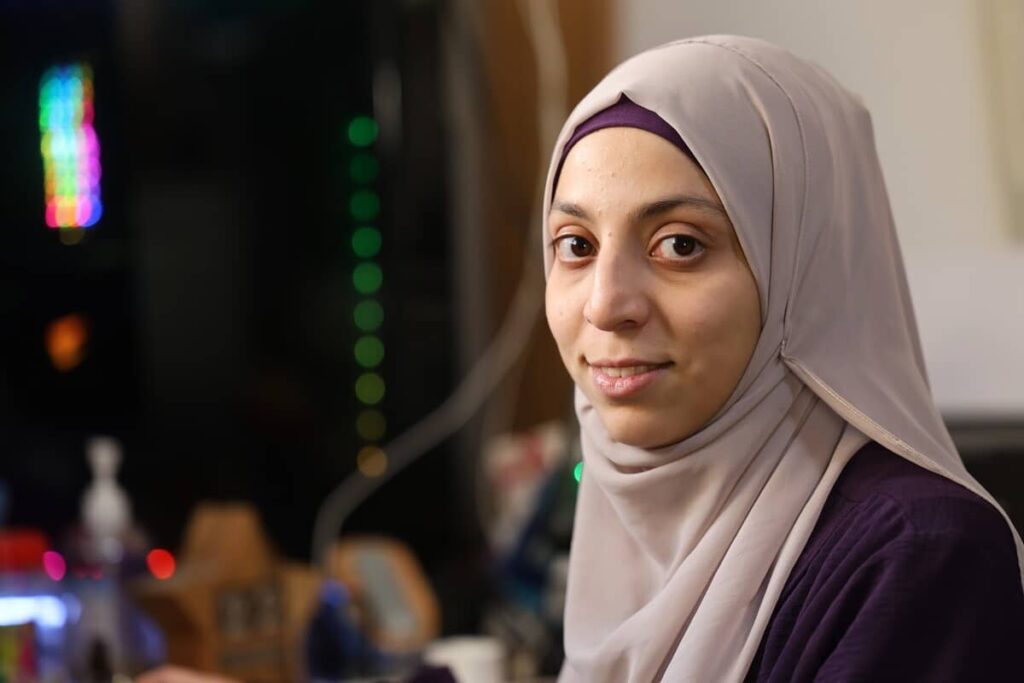
Walaa is a youth volunteer with the Humanitarian Youth Group Palestine (HYGP), a group that ActionAid supported in its establishment, provided with capacity building and incubated during its early development stages, which has members in both Gaza and the West Bank and trains young people in responding to emergencies.

The HYGP plays a crucial role in advocating for human rights and challenging the existing humanitarian architecture, particularly in Gaza, while also extending its influence to the West Bank, with members collaborating on advocacy initiatives and actively participating in decision-making bodies such as PNGO and the Education Cluster.  

Each day, Walaa visits shelters to find out what displaced people need and works to raise funds so they can buy crucial items. She also organises recreational activities to bring joy to traumatised children and has worked as a medical educator with medical missions in Gaza.  

Despite losing everything in this crisis, Walaa is determined to support others, telling ActionAid: “Life has changed since the beginning of the war, as [it has for] hundreds of thousands of [other] people in Gaza. We had been displaced multiple times. We were displaced from north to the south to seek refuge and find a safe place. I had lost my home, friends, work and everything. We pass through catastrophic conditions…but these conditions motivate me to continue my volunteerism and initiatives for supporting my people and draw the smile on the face of our children and elderly people with all possible means.” 
 
“It is important to help and support each other and find hope amid this darkness, because people in Gaza who are not killed with bombing, they will die with starvation, coldness, fear.” 

Khalid, a youth volunteer in Gaza who is also a member of the HYGP, has been supervising the distribution of hot meals and food to displaced people, and has helped coordinate the purchase of clothes and nappies for newborn babies in hospitals across southern Gaza. He has also designed activity sessions for children that provide psychological support and teach them about the dangers of approaching potential unexploded devices.  

Khalid told ActionAid that the challenges of life in Gaza had only made him more motivated to help his fellow Palestinians. “These hard conditions and reality encourage me to continue my work to achieve my noble aim of serving my community,” he said.  
 
He believes young people have a vital role to play in leading the humanitarian response in Gaza. Khalid said. “In all stages of humanitarian action, youth have much to contribute as we have good knowledge on social dynamics, geography, available resources and social and available networks, [and] can help our country to prepare for, respond to, and recover from crises…our firsthand experience of emergencies can bring nation-wide solutions for resilience, stability and peacebuilding.” 

Fouad, an experienced young humanitarian and one of the founding members of the HYGP, had to support people remotely after finding himself stuck in Egypt following October 7. He travelled home after attending a youth conference in Jordan and was unable to return to Gaza.

He said: “I started to suffer when I was separated from my family. I worked under pressure and anxiety due to the presence of my family and friends under bombardment.” 
 
Conditions in Gaza have made coordination with colleagues there extremely difficult. Fouad said: “[I] worked hard to coordinate with groups under disconnectivity and blackout communication most of the time and the constant displacement of youth groups. Some of the volunteers I work with were injured during the bombing, yet we did not stop fulfilling our duty.” 

The crisis in Gaza has had a severe toll on young people, affecting the wellbeing of an entire generation. Thousands of children have become orphans, and almost every young person will have lost a relative, friend or neighbour over the last ten months. Many have been injured or disabled as a result of Israeli military attacks; an average of 10 children lose one or both of their legs each day. All 625,000 school children in Gaza have lost an entire academic year of education, according to the Ministry of Health, and there are no jobs. Many young people will likely face long-term health consequences as a result of prolonged hunger and a lack of nutrition. Yet despite this, dedicated young people have played a crucial role in addressing the humanitarian crisis and will be just as vital in rebuilding Gaza when the crisis ends.  

Ms Balfe said: “From distributing fresh fruit and vegetables to starving families to providing comfort to traumatised children with games, painting and songs, young people are supporting their fellow Palestinians in Gaza in any way they can. With their ideas, energy and skills, their deep knowledge of their communities and their unwavering commitment, they have been able to provide truly valuable assistance to those in need, despite experiencing their own personal hardship and trauma.  
 
“The message of young people in Gaza is crystal clear: they want a permanent ceasefire, now, to put an end to this horror and so that they can start to hope for the future, fulfil their potential and help rebuild Gaza.”   

For more information about our work, click here.
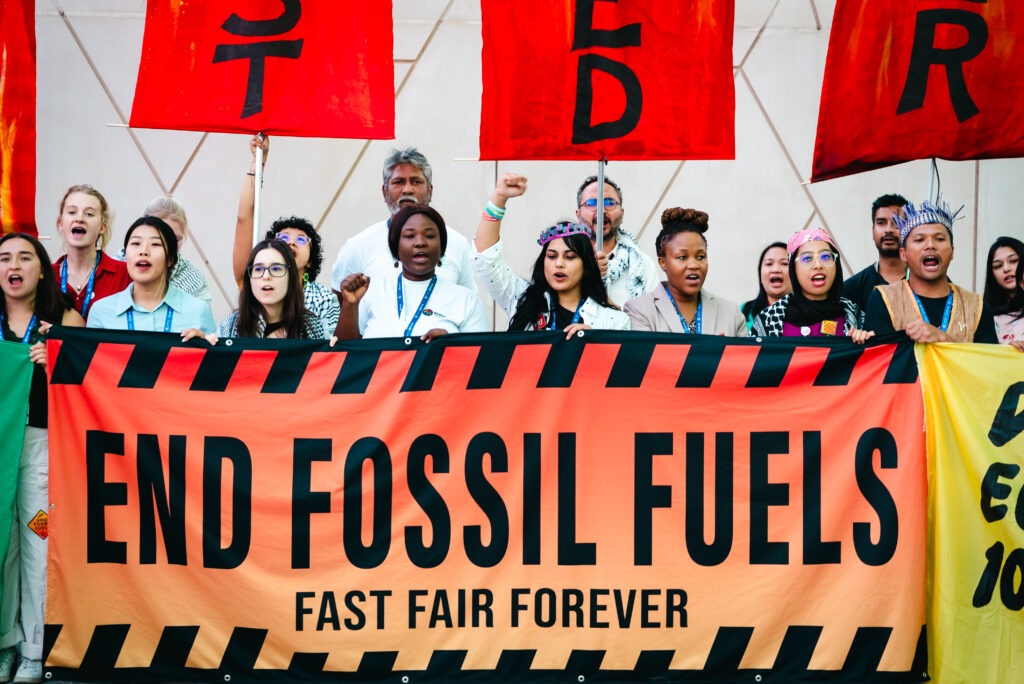
Protesters holding End Fossil Fuels banner at a climate demonstration, advocating for renewable energy solutions.

Protestors at COP 28 in Dubai. Photo: Konrad Skotnicki.

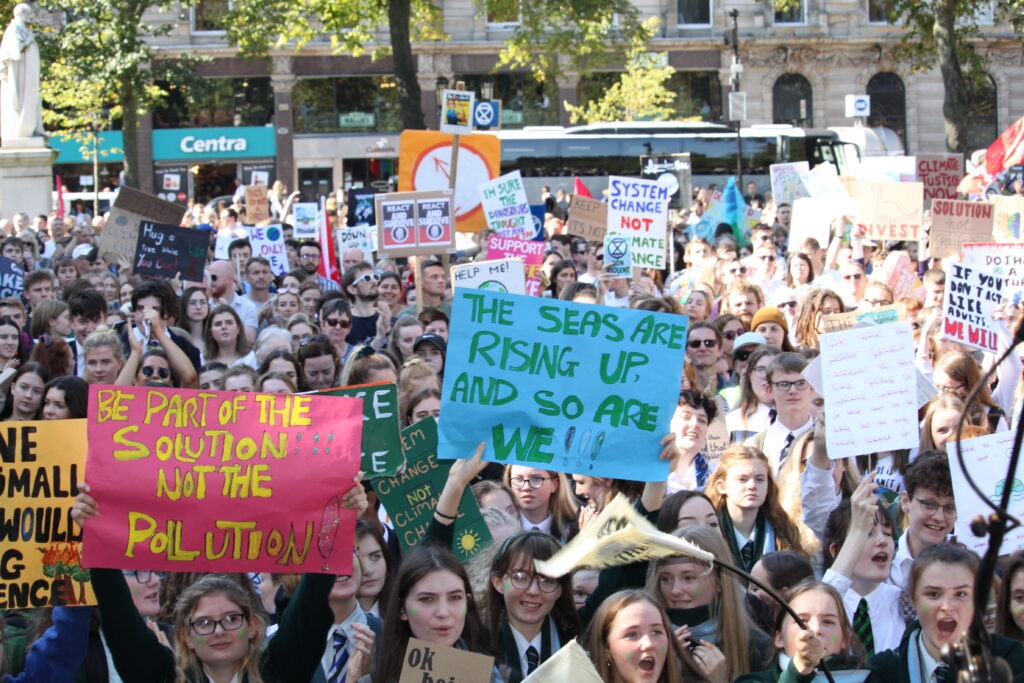
Climate protest with diverse crowd holding signs about environmental action in a city square.

Belfast Climate Change March, 2019. Photo: Trócaire.

The Profit Driving the Crisis

Despite their overwhelming contribution to global emissions, fossil fuel companies continue to attract significant financial backing—driven by their enduring profitability. This is starkly illustrated by the case of ExxonMobil, the top fossil fuel investment held by asset managers based in Ireland. In 2023, ExxonMobil reported €33.63 billion ($36 billion) in profit. That is almost twice the GDP of Botswana (€18.1 billion) and nearly three times Namibia’s GDP (€11.5 billion).

Ireland plays a hugely disproportionate role in facilitating investments into fossil fuel companies like ExxonMobil. In 2023, the investments made into fossil fuel companies by investment managers based in Ireland generated an estimated 72.5 million tons of CO2e. This is more than the CO2e emissions for the entire country of Ireland—and more than ten times that generated by Sierra Leone.

The Global Human Impact

The climate crisis is here, now, and it is causing disproportionate harm in the Global South. In Bangladesh, rising sea levels and increasingly severe cyclones are displacing coastal communities, with projections indicating that 17% of the entire country could be underwater by 2050. The legally binding Paris Agreement on climate change explicitly acknowledges the importance of tackling private finance. Its three overarching goals are: keeping below 1.5C of warming; increasing adaptation and making finance flows consistent with low emissions and resilience.

This gives a clear mandate for action:  both tax reform and corporate regulation are needed to tackle financial flows, and both nationally in Ireland and at EU level, ‘polluter pays’ taxes are lacking and regulation of the financial sector remains weak and fragmented. While EU regulation exists, it is designed more to nudge investors toward more sustainable investment practices by increasing transparency and reporting levels than to enforce strict standards. And it is moving in the wrong direction: the recently passed EU Corporate Sustainability Due Diligence Directive excluded investments; and now the EU Commission’s Omnibus legislative proposal threatens to undo the limited gains made on climate plans, as well as blocking future attempts for stronger action at national level.

The Risk of Inaction

Fossil fuel investment is too profitable to remain weakly regulated. If Ireland continues with its current strategy of encouraging FDI at all costs, and relying on weak EU regulation, we are headed for catastrophe. The Inter-governmental Panel on Climate Change has repeatedly warned that every fraction of a degree beyond 1.5°C brings irreversible consequences: collapsed ice sheets, vanishing coral reefs, and extreme weather events that will make vast regions of the planet uninhabitable. And yet, companies are developing oil and gas fields that could push global warming beyond 2°C.

Our research found that 91% of the investments made into fossil fuel companies by investment managers based in Ireland were to companies that have plans for fossil fuel expansion like these. Ireland cannot afford inaction on this issue.

About This Research

The figures in this report regarding investment from Ireland are based on new research commissioned by ActionAid Ireland and Trócaire. In the paper, we uncover the scale of fossil fuel investment through Ireland, who the investors are, and in which fossil fuel companies they are investing.  We analyse the current regulatory framework and explain why it is inadequate—and moving in the wrong direction. And we make specific recommendations for change, which are summarised below.

Summary of Recommendations

Regulate the private financial sector
Ireland must end its outsized role as an enabler of destructive fossil fuel investment. Ireland should introduce a strong gender-responsive national human rights and environmental due diligence framework which includes the regulation of investors with respect to human rights and the environment and climate. The transposition of the EU Corporate Sustainability Due Diligence Directive could achieve this if downstream activities are included and the Omnibus proposal is rejected. Ireland should prohibit investments in fossil fuel expansion and require investors to implement climate transition plans consistent with a 1.5°C climate limit.

Endorse the Fossil Fuel Non-Proliferation Treaty
Ireland should endorse developing a Fossil Fuel Non-Proliferation Treaty to curb fossil fuel expansion and commit to a fair and funded phase out of fossil fuels.

Support tax justice
Ireland should support bold and fair new global tax rules through the UN Framework Convention on Tax, should adopt all OECD BEPS measures, and should conduct an updated and comprehensive spillover analysis of its tax policy. Ireland should take coordinated action globally, at the EU level and domestically to introduce a range of new taxes to mobilise finance needed for climate justice, based on ‘polluter pays’ and social equity principles such as wealth taxes for the highest earners, climate damages tax on investors, fossil fuel production taxes and levies on aviation and shipping.

Finance a just transition
Ireland must also meet its fair share climate finance obligations under Article 9.1 of the Paris Agreement, and pay our ecological debt to the Global South. Ireland should support conditionality-free debt cancellation for countries on the front lines of the climate crisis, commit to a new UN Framework Convention on Sovereign Debt, moving debt negotiations from the IMF to the UN, and to a debt workout mechanism that is fully representative and fair.

Further reading